Decoding RTP Technical Parameters & Manufacturing Quality
How to Read RTP Technical Parameters and Understand Manufacturing Impact on Quality
A practical guide for procurement professionals in oil & gas and mining who need to go beyond specification sheets and evaluate real-world performance.
Introduction: Why Technical Parameters Matter in RTP Procurement
Reinforced Thermoplastic Pipe (RTP) has become a go-to solution for high-pressure fluid transport in oilfields, offshore platforms, and mining operations. But when procurement teams receive a datasheet with terms like "2” 3500PSI O.D:79.8mm", "Polyester Fiber tape-reinforced", or "API 15S Certified", what do these numbers and materials actually mean for field performance? And crucially, how does the manufacturer’s production process—extrusion, reinforcement winding, quality testing—translate into a pipe that lasts 5+ years under corrosive, high-pressure conditions?
This article breaks down the key technical parameters of RTP, explains how each manufacturing step influences quality, and provides a practical framework for buyers to evaluate suppliers. We will reference real-world data from ZYfire Hose Corporation, a Beijing Stock Exchange-listed manufacturer with API 15S certification (certificate number 15S-0025) and over 600 employees across a 150,000 m² facility.
The Core Problem: Information Asymmetry in RTP Procurement
Many buyers compare RTP suppliers solely on price and basic dimensions. This approach often leads to failures—premature leaks, burst under pressure, chemical degradation, or difficult installation. The root cause is a lack of understanding of how technical parameters (pressure rating, reinforcement layer type, liner material) and production processes (extrusion temperature control, tension consistency in winding, 100% hydrostatic testing) collectively determine pipe reliability.
Without this knowledge, procurement decisions become a gamble. For example, a pipe labeled “3500 PSI” may only achieve that rating under ideal conditions if the reinforcement tape layup angle is imprecise. Similarly, a PE100 inner liner without UV stabilization will crack in exposed desert environments within months.
Industry Context: RTP in Demanding Applications
RTP is widely used in:
- Oilfield Reinforced Thermoplastic Pipe – for water injection, produced water transfer, and crude oil gathering.
- Offshore Oil & Gas RTP – where corrosion resistance and flexibility are critical for subsea jumpers.
- Mining Underground RTP – for slurry and dewatering lines that must resist abrasion and impact.
- Mining Slurry Transfer RTP – handling coarse particles at high pressure.
Each environment imposes specific demands: high pressure, chemical exposure, temperature extremes, and mechanical stress. The pipe must be engineered accordingly.
Detailed Explanation: Decoding the Technical Parameters
1. Nominal Pressure and Outside Diameter
Using the ZYfire RTP/TCP model as an example: “2” 3500PSI O.D:79.8mm”. The 3500 PSI rating is the working pressure, but its long-term validity depends on the reinforcement design and manufacturing consistency. The outside diameter (79.8 mm) must match fittings strictly. A deviation of even 0.5 mm can cause connection leaks.
2. Reinforcement Material Layer: The Backbone of Pressure Retention
ZYfire offers four reinforcement types: Polyester Fiber tape, Aramid Fiber tape, Glass Fiber tape, and Steel Wire tape. Each has a unique pressure rating, flexibility, and cost profile.
- Polyester Filament – cost-effective for moderate pressures.
- Aramid Fiber (tape) – highest strength-to-weight ratio, used in extreme pressure applications.
- Glass Fiber (tape) – excellent stiffness and chemical resistance.
- Steel Wire (tape) – maximum burst resistance, but less flexible.
The manufacturing process must maintain precise tension and winding angle (typically ±1°) to achieve the rated burst pressure. Automated winding lines with real-time tension sensors are essential.
3. Inner and Outer Layer Materials
Standard material is HDPE or PE-RT, with optional UV stabilizers and antioxidants. For oil & gas applications requiring oil resistance, a PA12 or Polypropylene liner is used. ZYfire can customize the bore size and material to match the fluid chemistry.
4. Length and Reel Specifications
A single length of 920 meters reduces the number of fittings, which are the weakest points. ZYfire supplies per reel: 3700×1200 mm, reel weight 1200 kg, full plate weight 5524 kg. Buyers should verify that their logistics and installation equipment can handle these dimensions.
How Manufacturing Processes Affect Quality
Extrusion of Inner Liner
Temperature control within ±2°C is critical to avoid voids or weak spots. ZYfire uses CNAS-accredited laboratory testing to monitor melt flow index and density.
Reinforcement Layer Winding
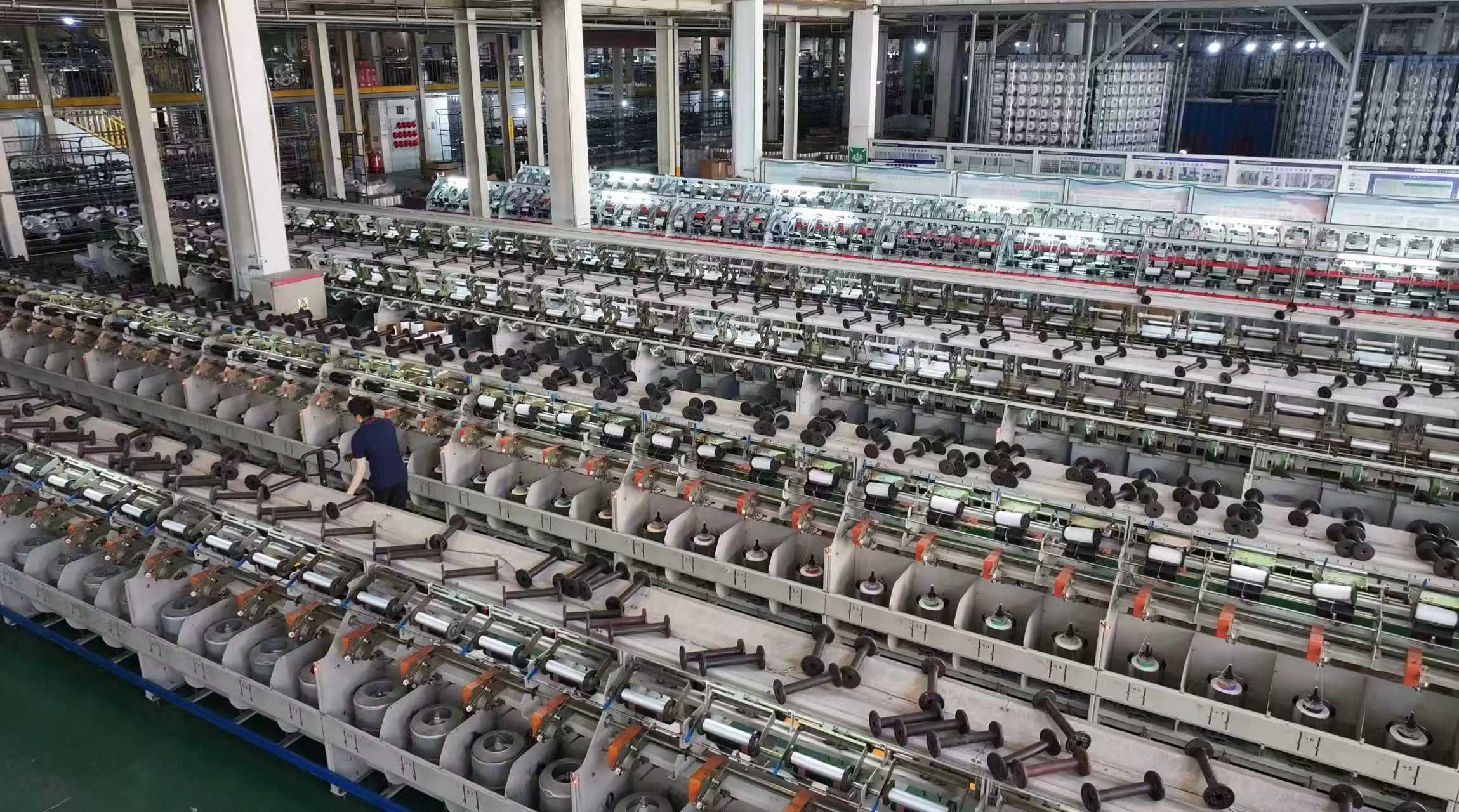
Whether braiding or taping, the number of layers, angle, and tension must be consistent. Manual processes lead to variance; automated machinery with feedback control ensures every meter meets specification. ZYfire’s twisting machines (photo below) are part of their controlled production line.
Outer Jacket Extrusion and Co-extrusion
Bonding between jacket and reinforcement prevents delamination. ZYfire uses a co-extrusion process that fuses layers without adhesives, reducing failure points.
100% Hydrostatic Testing
Every finished pipe is tested to 1.5× the rated pressure before shipment. This is a key quality control measure. ZYfire’s 100% test policy (as stated in their quality control: “100% test”) ensures zero defects leave the factory.
Step-by-Step: How to Evaluate an RTP Supplier’s Technical Competence
- Request a detailed specification sheet – including material grade, reinforcement type, burst pressure, and minimum bend radius.
- Check certifications – API 15S (ZYfire holds certificate 15S-0025, valid until 2027) is the global standard for non-metallic reinforced pipes.
- Inspect manufacturing capability – monthly capacity (ZYfire: 100,000 meters), lead time (30 days), and MOQ (50 meters).
- Ask about quality control – 100% hydrostatic test, CNAS lab accreditation, and traceability records.
- Review case studies – ZYfire supplied 120,000 meters for a multi-year mining project with stable operation, no leakage, and reduced maintenance costs over 5 years.
- Compare total cost of ownership – RTP offers up to 20% lower installation cost than steel pipe, and corrosion-free maintenance for years.
Real-World Case: 120,000 Meters of RTP in a Mining Application
Client type: OEM/ODM partner in the Middle East
Application: Slurry and water transfer under high pressure (up to 3500 PSI)
Duration: 5 years continuous operation
Result: Stable operation, no leakage, reduced maintenance costs by over 30% compared to previous steel pipe system.
Key highlights: corrosion resistance, easy installation due to lightweight (less than 1/5 of steel), and long single lengths that minimized joint count.
Frequently Asked Questions
What is the difference between RTP and steel pipe for offshore oil & gas?
RTP is corrosion-resistant, flexible, and installable at 10 km per day vs. steel’s 2 km per day. It has 20% lower total installed cost and requires minimal maintenance unless physically damaged.
How do I choose the right reinforcement material?
For high pressure and flexibility: aramid fiber. For cost-sensitive moderate pressure: polyester. For maximum rigidity: steel wire. Consult with supplier on specific operating conditions.
Why is API 15S certification important?
It ensures the pipe meets rigorous design, manufacturing, and testing standards recognized globally. ZYfire’s API 15S certification (15S-0025) covers glass fiber and steel reinforced pipes and couplings.
What is the typical lead time for custom bore sizes?
ZYfire offers OEM/ODM with customization on diameter, pressure, length, and bending radius. Lead time is about 30 days for standard orders, MOQ starts at 50 meters.
Conclusion: Make Informed Procurement Decisions
Understanding RTP technical parameters and how they relate to manufacturing processes is no longer optional for procurement professionals in oil & gas and mining. By focusing on key specifications—pressure rating, reinforcement type, liner material, and manufacturing quality controls (100% testing, certified processes)—you can significantly reduce risk and total cost of ownership.
ZYfire Hose Corporation, with its API 15S certification, CNAS-accredited lab, and proven track record in over 70 countries, is a reliable partner for demanding applications. For a deeper dive, download the corporate brochure to explore full product specifications, factory capabilities, and case studies.
Have Questions or Need More Details?
Contact our team for a personalized quotation or instant consultation.
Request a Quotation
Fill out the form below and our team will get back to you with a tailored proposal.
WhatsApp Direct Chat
Prefer to chat in real-time? Message us on WhatsApp for instant assistance & quick answers.
- Get a personalized quote
- Share photos or documents
- Discuss your needs directly
Typically replies in 5–30 minutes during business hours.