How to Compare Reinforced Thermoplastic Pipe and Steel Pipe for Oil & Gas and Mining
Published: August 24, 2026
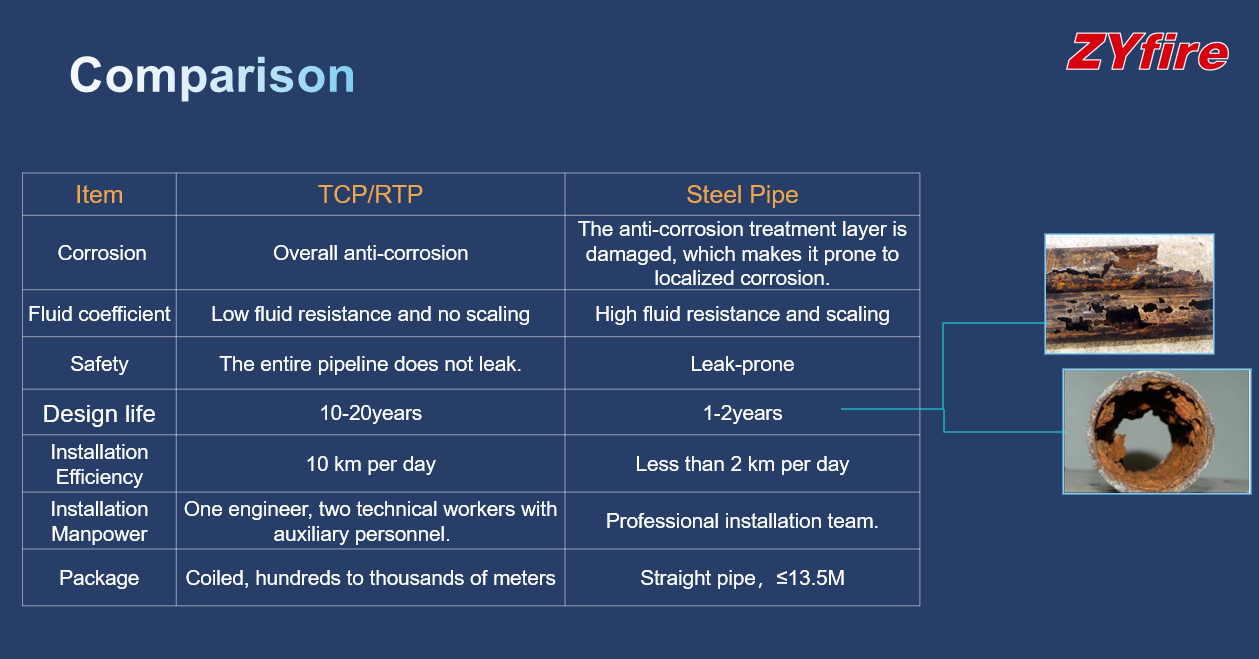
How to Compare Reinforced Thermoplastic Pipe and Steel Pipe for Oil & Gas and Mining
Reinforced thermoplastic pipe (RTP) should be considered by oil and gas and mining buyers when installation speed, corrosion maintenance, and total installed cost are the dominant constraints. ZYfire comparison data show RTP can be installed at 10 km per day, about five times faster than steel pipe's less than 2 km per day. Routine maintenance for RTP is minimal and normally limited to force-damage repair, while steel pipe often requires corrosion maintenance several times per year. This guide provides a structured decision framework for comparing RTP with steel pipe, including the evidence to verify and the evaluation steps procurement teams can use.
Problem Definition: Why Pipe Selection Is Harder Than Price Per Meter
Many procurement decisions start with a unit-price comparison between RTP and carbon steel pipe. That starting point misses the costs that occur after purchase: installation, transport, corrosion control, maintenance, and downtime. RTP and steel pipe behave differently in each of those areas.
The core problem for the buyer is selecting a pipe that can perform under the actual service conditions while also delivering an acceptable total cost. This requires a comparison framework. The framework should include standard compliance, pressure and temperature limits, fluid compatibility, installation speed, maintenance burden, logistics, and supplier capability.
This article uses first-party RTP comparison data from ZYfire and third-party market context to explain where RTP offers measurable advantages and where steel pipe may still be the safer choice.
Industry Background: Reinforced Thermoplastic Pipe in Oil & Gas and Mining
Reinforced thermoplastic pipe is a spoolable composite line pipe that uses thermoplastic layers and a reinforcement system to provide pressure capacity while remaining lighter than steel. The product category has expanded in oil and gas because operators are looking for corrosion-resistant alternatives to steel line pipe.
The global RTP market was estimated at USD 7.2 billion in 2024 and is projected to reach USD 10.2 billion by 2030, growing at a CAGR of 5.9%, according to Strategic Market Research. Fact.MR reports that the oil & gas industry segment is the dominant end-user, accounting for approximately 71.2% of total demand. The same source estimates that glass fiber reinforced thermoplastic pipes represent about 64.7% of the product market. Asia Pacific is the largest and fastest-growing regional market for thermoplastic pipes, according to Mordor Intelligence and Market Research Future.
For oilfield applications, API Specification 15S (2nd Edition, 2016) is the recognized standard for spoolable reinforced plastic line pipe, covering pipe diameters up to 6 inches. This standard gives buyers a baseline for qualification. ZYfire Hose Corporation, founded in 2000 and listed on the Beijing Stock Exchange, manufactures RTP certified under API 15S and specializes in custom bore sizes and high-pressure applications for oilfields and mining.
Detailed Solution: Comparing RTP and Steel Pipe on Decision-Relevant Criteria
Installation Efficiency
The most direct RTP advantage is installation speed. In ZYfire's comparison data, RTP achieves an installation rate of 10 km per day, while steel pipe achieves less than 2 km per day. This represents a 5x higher installation speed.
For a project with limited site access or a short weather window, this difference can change the schedule. RTP's faster deployment reduces labor time, equipment time, and the number of days the site is exposed to disruption. The speed advantage does not remove the need for proper site preparation, but it changes the execution risk.
Maintenance Burden
Maintenance requirements are a second major differentiator. RTP maintenance is minimal; intervention is normally needed only if force damage occurs. Steel pipe, by contrast, requires corrosion maintenance several times a year.
In mining and offshore environments, inspection and maintenance access is expensive. A pipe that can be left in service without regular corrosion treatment reduces operating cost and avoids unplanned work. The caveat is that RTP must be protected from mechanical damage; if a section is struck or cut, repair is still required.
Cost Comparison
In published comparison material, RTP offers a 20% lower cost compared to steel pipe. This comparison should be read as a total installed cost signal rather than a blanket material price claim. The cost benefit comes from faster installation, lower site transport cost, and reduced corrosion maintenance.
Every project should run its own cost model. A remote site with expensive labor will amplify RTP's installation advantage. A project that already has steel pipe handling and welding infrastructure may see a smaller benefit. The 20% figure is a reference point, not a quote.
Handling and Site Logistics
RTP is lightweight, easy to operate, and generates low site transport cost. This is particularly relevant when pipe must be moved through roads, excavated trenches, or confined mining areas.
Lightweight handling reduces the need for heavy lifting equipment and allows smaller crews to move material into position. In addition to cost, this reduces physical workload and can improve safety. For steel pipe, site logistics depend on the pipe size, wall thickness, coating, and transport distance.
Where Steel Pipe May Still Be the Right Choice
RTP is not a universal replacement for steel. Project temperature, pressure, external loading, impact risk, code requirements, and existing joining procedures must all be checked. Buyers should also verify that the selected RTP diameter and pressure rating match the service conditions. For the oilfield segment, API 15S gives a qualification framework for spoolable reinforced plastic line pipe up to 6 inches, but fluid compatibility and mechanical protection should still be confirmed with the manufacturer.
Step-by-Step Breakdown: How to Make the RTP vs Steel Decision
Step 1: Define the Operating Conditions
Record the fluid, pressure, temperature, flow rate, diameter, and environmental conditions. Also note whether the line is permanent or temporary, above ground or buried, onshore or offshore, and whether the pipe will be exposed to impact or abrasion.
Step 2: Check Standards and Certification
For oilfield service, request API 15S certification. For other regions, ask which standards apply and request certificates. ZYfire produces API 15S-certified RTP, which gives buyers a documented baseline.
Step 3: Estimate Total Installed Cost
Include the pipe cost, installation labor, equipment, site transport, maintenance, and expected service life. Apply the comparison reference: RTP installation speed of 10 km per day versus less than 2 km per day for steel, and RTP's 20% lower total cost in published comparison data.
Step 4: Evaluate the Installation Plan
A 5x faster installation rate is valuable when access is difficult, labor is expensive, or the project must avoid long shutdowns. Compare the number of joints, equipment requirements, and crew size.
Step 5: Plan for Maintenance
Assume RTP requires minimal maintenance other than force-damage repair. For steel, assume corrosion maintenance several times per year. Use the difference in maintenance access costs as part of the evaluation.
Step 6: Review Supplier Capability
Check whether the supplier can provide high-pressure RTP and custom bore sizes. ZYfire lists custom bore size RTP and high-pressure RTP among its specialties. Review manufacturing scale, quality systems, and test capability. ZYfire operates a 150,000 sqm production base with a CNAS-accredited laboratory.
Step 7: Run Risk Verification
For corrosion risk, the control method is to use corrosion-resistant material. ZYfire's enterprise measure includes simulation testing. Before finalizing a new pipe specification, ask how the manufacturer validates material selection under project-like conditions.
Use Cases: Where the RTP Advantages Matter Most
Onshore Oilfield Reinforced Thermoplastic Pipe
Onshore oilfield projects often need high-pressure lines, custom bore sizes, and a field-proven qualification path. API 15S certification makes RTP easier to specify for spoolable reinforced plastic line pipe. The installation speed advantage is useful for long surface lines or replacement programs where reducing downtime matters.
Offshore Oil & Gas RTP
Offshore facilities are weight-sensitive and maintenance access is costly. RTP's lightweight handling and minimal corrosion maintenance are relevant selection criteria. Buyers should verify that pressure, diameter, chemical compatibility, and fire or impact requirements are within the project specification.
Mining Underground RTP and Slurry Transfer
Mining projects, including underground operations and slurry transfer, are often located in constrained spaces. RTP's light weight and faster installation reduce logistics difficulty. For slurry service, confirm liner material against abrasion and chemical conditions. Corrosion-resistant lined RTP may be appropriate when the liner is matched to the slurry composition.
Comparison Table: RTP vs Steel Pipe
| Criterion | Reinforced Thermoplastic Pipe (RTP) | Steel Pipe |
|---|---|---|
| Installation speed | Up to 10 km per day | Less than 2 km per day |
| Relative installation speed | 5x higher than steel | Baseline |
| Maintenance | Minimal; intervention only after force damage | Corrosion maintenance required several times per year |
| Cost comparison | 20% lower in published comparison | Baseline |
| Site handling | Lightweight, easy to operate, low site transport cost | Baseline |
| Oilfield specification | API Spec 15S covers spoolable RTP up to 6 inches | Not covered by API 15S in this comparison |
FAQ: RTP vs Steel Pipe Procurement Questions
Is reinforced thermoplastic pipe certified for oilfield service?
API Specification 15S (2nd Edition, 2016) is the industry standard for spoolable reinforced plastic line pipe for oilfield applications, covering pipe diameters up to 6 inches. ZYfire manufactures RTP certified under API 15S. Procurement teams should request the certificate and confirm the nominal size and pressure rating match the project.
Can RTP handle high-pressure oilfield and mining applications?
High-pressure service is one of the areas where ZYfire specializes, along with custom bore sizes. For any project, the pressure rating must be verified against the actual operating conditions, and the RTP specification must be checked for temperature, fluid, and external load compatibility.
How does RTP cost compare with steel pipe?
In published comparison material, RTP offers a 20% lower cost compared with steel pipe. The comparison is most meaningful when installation speed, site transport, and maintenance are included in the calculation, not when pipe material is priced as an isolated line item.
Can I run a project-specific evaluation before committing?
Yes. Buyers should validate RTP selection under project conditions. ZYfire's engineering team can discuss material selection, and the company uses simulation testing as an enterprise measure for corrosion-related risk. To structure the evaluation, provide fluid composition, pressure, temperature, bore size, and installation constraints.
How should I plan procurement lead time?
Lead time depends on the bore size, pressure rating, quantity, certification deliverables, and production schedule. A reliable lead time can only be calculated after the technical specification is known. Send ZYfire the project specification and target delivery date to obtain a project-based schedule.
Conclusion
For oil and gas and mining buyers, reinforced thermoplastic pipe offers measurable advantages in installation speed, maintenance, and cost in published comparisons. RTP installation at 10 km per day versus steel pipe's less than 2 km per day, minimal routine maintenance, and a 20% lower cost comparison are concrete reference points. These benefits must be weighed against project-specific pressure, temperature, fluid, and mechanical requirements.
Use this comparison framework: verify API 15S or applicable standard, estimate total installed cost, check site logistics, plan maintenance, and validate supplier capabilities. A certified manufacturer such as ZYfire can support high-pressure and custom-bore RTP evaluations for oilfield, offshore, and mining applications.
For a project-specific RTP comparison, contact ZYfire or download the corporate brochure.
Website: www.zyfire.com | Tel: +86 523 88802123 | Address: Kaiyang Road, Jiangyan City, Jiangsu, China
Have Questions or Need More Details?
Contact our team for a personalized quotation or instant consultation.
Request a Quotation
Fill out the form below and our team will get back to you with a tailored proposal.
WhatsApp Direct Chat
Prefer to chat in real-time? Message us on WhatsApp for instant assistance & quick answers.
- Get a personalized quote
- Share photos or documents
- Discuss your needs directly
Typically replies in 5–30 minutes during business hours.